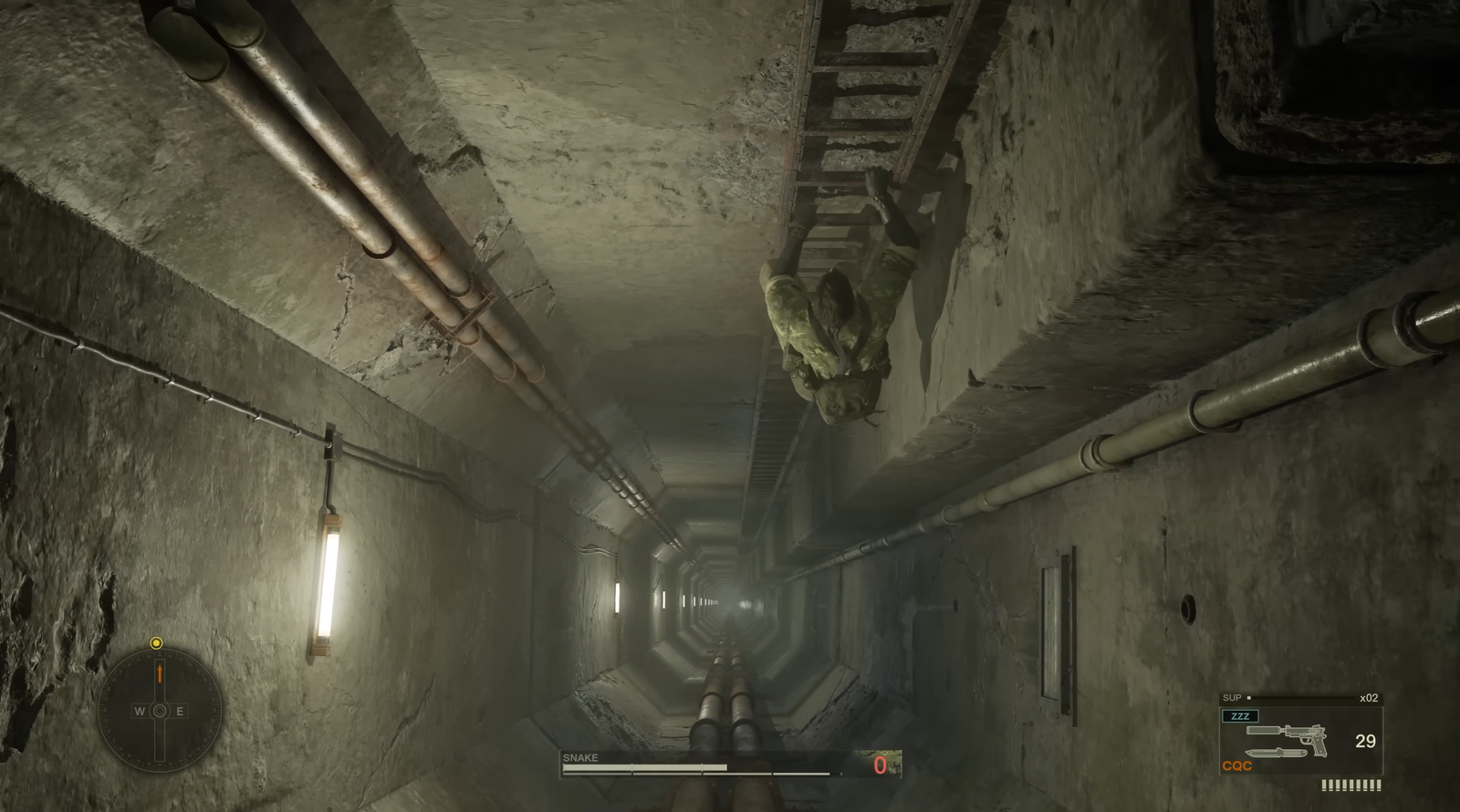
METAL GEAR SOLID DELTA: SNAKE EATER
ARTIFACT #5: GAMEPLAY SCREENSHOT
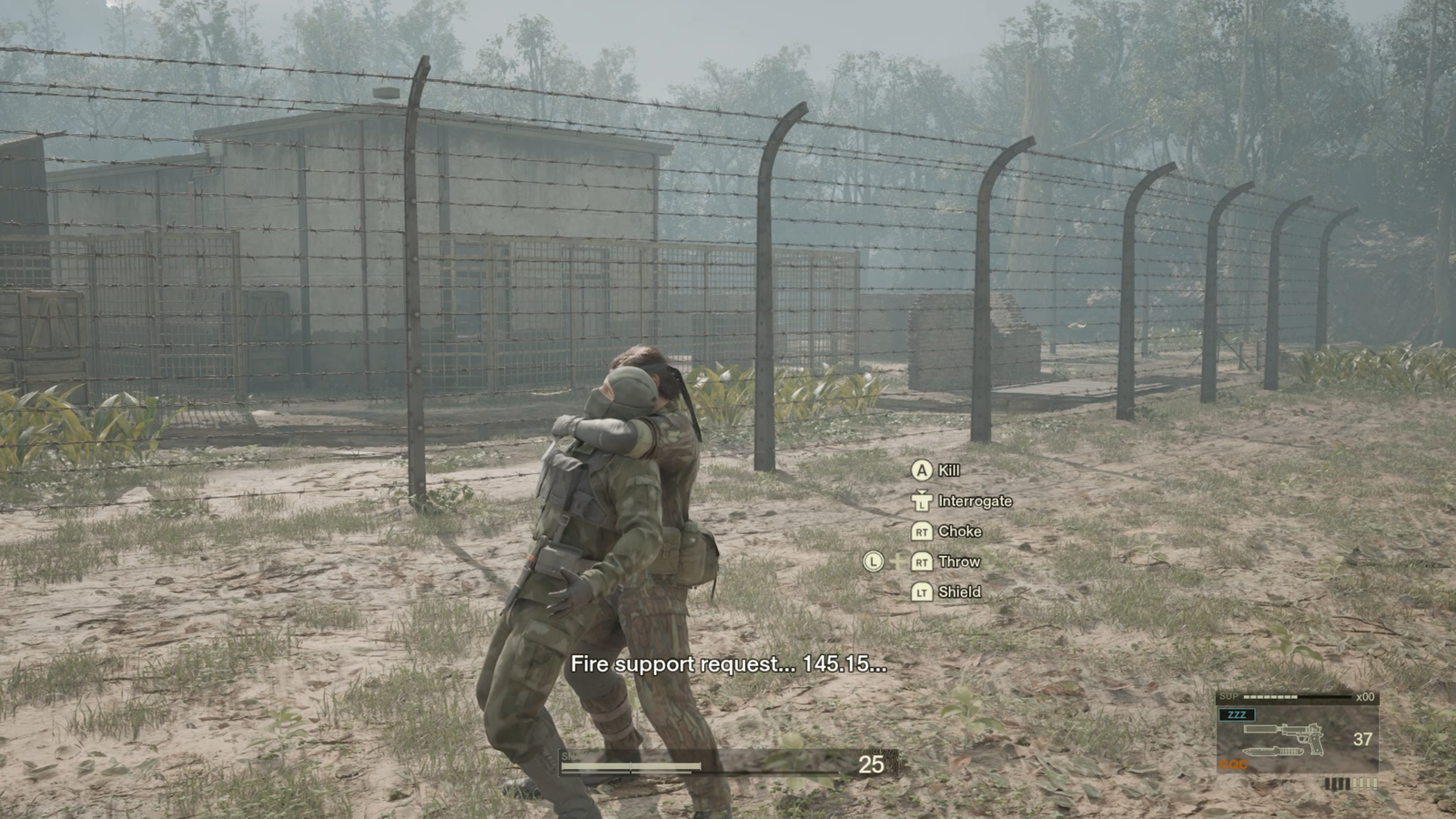
With the release of Unreal Engine 5, Metal Gear Solid Delta: Snake Eater had a great opportunity to remake a fan favorite stealth game with a modern twist. Above is Naked Snake, depicted interrogating a guard at Bolshaya Past Base. In the background, the base lies surrounded by barbed wire and arid vegetation. The foreground shows Naked Snake choosing the “Interrogate” option; the guard gives Snake a secret frequency for “Fire Support”, which the player can actually use in game to bomb enemies. To the right of the models, a list of options is presented that the player can use when they have an enemy in a choke hold, including kill, interrogate, choke, throw the enemy, and use the enemy as a human shield. In the middle-bottom, Snake’s stats are shown. Beneath “Snake” is the health bar and below that is the stamina bar. The stamina bar helps Snake with quicker health regeneration and steady aim; less stamina means Snake has a slower health regeneration and shaky aim. On the other end of the bars is “25%”. This represents how well Snake is camouflaged compared to his background; the higher the percentage, the less likely enemies are to detect Snake. So, choosing the right camo and face paint is essential, which has been optimized in MGS Delta by pressing a button to select camo rather than navigating the menu to equip camo (not pictured). On the bottom-right, Snake’s equipped weapon is shown. Snake is actively using a tranquilizer with a suppressor, represented with “ZZZ” and “SUP—x00” respectively, and has 37 tranquilizer darts remaining, with 4 more darts left before he needs to reload (depicted with 4/8 highlighted vertical bars under the weapon). The orange CQC, Close Quarters Combat, underneath the weapon image indicates that the tranquilizer gun can be used to perform specialized takedowns. The screen itself has very little clutter and the player can view a good amount of their current environment.
This artifact illuminates the changes to the mechanical aspect of Metal Gear Solid Delta: Snake Eater. Since the game focuses on tactical espionage action, it is monumentally important for the player to be aware of their surroundings; thus, visual indicators and icons have been reduced in size and modernized with a sleek, minimal design. CQC actions have become easier to perform. In Metal Gear Solid 3: Snake Eater, the player had to memorize what actions they had available with little on-screen queues; now, a helpful button map is always presented during CQC and other parts of the game when an action can be taken, giving players more certainty about the actions they take. Similarly, the inclusion of the camouflage menu helps players stay immersed in their game and spend less time navigating the menu. MGS Delta preserves the original game through the continuity of the menu layout, weapon placement, and item placement, allowing returning players to navigate the game much easier; reusing the same environments and weapons reinforces this continuity, producing nostalgia as experienced players engage with the enhanced game design while revisiting iconic locations. Not depicted, but equally important, are the shooting controls. With the rise of multiplayer PvP games during the past decade, players have familiarized themselves with over-the-shoulder shooting schematics. MGS3 only has first person shooting and Snake stands still when doing so. In order to modernize the game, MGS Delta incorporates over-the-shoulder shooting with slight movement when aiming to allow players to feel more comfortable with the controls. This gameplay screenshot reveals that the developers behind Metal Gear Solid Delta: Snake Eater created a remake with the player in mind by creating quality-of-life upgrades to exploration, stealth, and shooting.
EXPLORE


WORKS CITED
- Microsoft Copilot was in the composition of the artifact descriptions, for editing purposes. Copilot offered conciseness and clarity suggestions and checked spelling/grammar
ARTIFACT #5: GAMEPLAY SCREENSHOT
- Randell, Laura-May. 25 Aug. 2025. How to Interrogate Enemies – IGN, https://www.ign.com/wikis/metal-gear-solid-delta-snake-eater/How_to_Interrogate_Enemies. Accessed 6 Mar. 2026.
HEADER
- IGN. “Metal Gear Solid Delta: Snake Eater – Iconic Ladder Scene in 4K.” YouTube, YouTube, 25 Aug. 2025, www.youtube.com/watch?v=cLgPGTPBAog. Accessed 06 Mar. 2026.
EXPLORE
- Asgartinus. Persona 5 Royal Cover Art Enhance Resolution + PNG Version : R/Persona5, https://www.reddit.com/r/Persona5/comments/pe8j4f/persona_5_royal_cover_art_enhance_resolution_png/. Accessed 14 Feb. 2026.
- BeastXredefined. FFVII Rebirth Box Art : R/FinalFantasy, https://www.reddit.com/r/FinalFantasy/comments/1bnm1hx/ffvii_rebirth_box_art/. Accessed 14 Feb. 2026.
- Thibaut. 9 June 2024. Metal Gear Solid Delta: Snake Eater Appears Again with Lots of Gameplay, https://news.instant-gaming.com/en/articles/6836-metal-gear-solid-delta-snake-eater-appears-again-with-lots-of-gameplay. Accessed 28 Feb. 2026.